Introduction
Online retail has grown more competitive than ever before. Customers compare prices within seconds, leave carts without completing purchases, and expect personalized experiences on every store visit. Retailers who rely on assumptions rather than evidence are consistently outpaced by those who make decisions based on real data.
E-commerce analytics closes that gap. It gives retailers a structured way to examine what is happening across their store, understand why it is happening, and act on that understanding with confidence. Instead of responding to problems after they surface, retailers with strong data analytics for e-commerce infrastructure anticipate issues and correct course early.
This guide covers the full scope of e-commerce analytics, from core definitions and metric frameworks to tool selection and practical strategy. Every section is written to give retailers actionable clarity, not just conceptual overview.
What Is E-commerce Analytics?
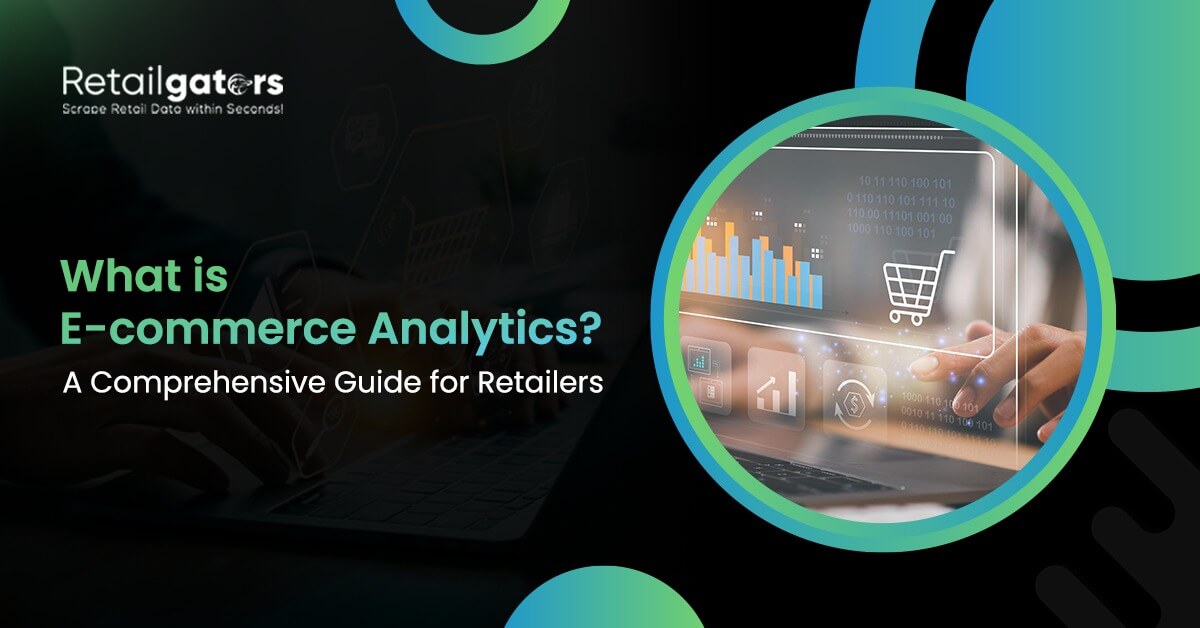
E-commerce analytics refers to the ongoing process of collecting, organizing, and interpreting performance data generated across an online retail environment. This includes transaction records, traffic behavior, customer journey data, marketing attribution, and product level performance, all examined together to support better business decisions.
The practical range is wide. It will include the understanding of what channels produce buyers instead of just browsers, what product pages are effective in converting customers vs. those that cause customers to leave before completing their purchase, where the checkout process breaks down, as well as identifying customer segments that provide the greatest extent of long term value. Data Analytics for e-commerce will enable businesses to make data-driven decisions proactively rather than reactively.
Relevant benchmarks that frame the opportunity:
- According to Statista, global e-commerce sales will exceed $6.3 trillion by 2026.
- The average rate of people leaving their shopping carts around the world is 69.8% (Baymard Institute).
- According to Forbes Insights, companies that use data-driven marketing get 5 to 8 times more return on investment than those that use traditional approaches.
Why Does E-commerce Analytics Matter for Retailers?
Retailers that outperform their market consistently, have one defining characteristic – they leverage retail analytics solutions to validate every major decision before acting on assumptions. The effects of utilizing this type of tool are felt throughout the company as it relates to business impact in a variety of ways:
- Revenue leak identification: Pinpoint where customers exit before completing a purchase and address those gaps with targeted fixes.
- Marketing channel efficiency: Determine which sources, whether paid search, organic, email, or social, produce genuine conversions rather than empty traffic.
- Customer retention improvement: Apply customer behavior analytics to build audience segments and deliver personalized offers that increase repeat purchase rates.
- Assuring Inventory: Analyze seasonal trends and product sales trends to make sure you stock the right products and do not inventory products that move slowly, thereby tying up capital.
- Pricing: the sensitivity of your audience to price and your competitors’ pricing to confidently adjust your price instead of just instinctively.
The retailers gaining ground in competitive markets are not always the largest. They are the most analytically capable. RetailGators was built for this principle, giving retailers at every scale the tools to make each business decision count.
What Are the Core Types of E-commerce Analytics?
Understanding the four primary categories helps retailers build a more complete view of their business performance rather than relying on isolated reports.
- Analytics that describe answers the question: What happened? It includes historical data on sales volume, traffic patterns, and conversion activity. This is where all retail analysis begins
- Diagnostic Analytics answers the query: “What happened?” It looks at the reasons for changes in performance, such as figuring out why a certain product page has a high exit rate.
- Predictive analytics answers the question: “What will happen?” Machine learning models look at patterns to guess how much demand there will be in the future, how likely it is that customers will leave, and how much they will be worth over time.
- Prescriptive analytics answers the query: “What should I do?” This group suggests precise, data-backed actions to boost sales, keep customers, or cut costs.
Most retailers begin with descriptive reporting and expand their capability over time. However, competitive separation happens at the predictive and prescriptive levels. Advanced analytics for retail platforms have made these capabilities far more accessible to businesses outside the enterprise tier.
Which E-commerce Performance Metrics Matter Most?
Monitoring every available metric produces noise rather than insight. The e-commerce performance metrics below have the most direct and measurable connection to revenue, retention, and operational efficiency.
| Metric | Definition | Business Relevance | Reference Benchmark |
|---|---|---|---|
| Conversion Rate | Buyers divided by total visitors | Measures overall store effectiveness | 2 to 4 percent for retail |
| Customer Acquisition Cost | Marketing spend divided by new customers gained | Evaluates channel efficiency | Monitor directional trends |
| Customer Lifetime Value | Projected total revenue per customer | Guides retention budget allocation | CLV to CAC ratio above 3 to 1 |
| Cart Abandonment Rate | Incomplete checkouts as a percentage of started ones | Identifies purchase flow friction | Industry average near 70 percent |
| Average Order Value | Revenue divided by total order count | Reflects upsell and bundle performance | Varies by category |
| Return on Ad Spend | Revenue generated per dollar of advertising investment | Measures paid campaign profitability | 4 to 1 considered strong |
| Bounce Rate | Sessions ending after a single page view | Signals relevance or UX problems | Below 40 percent preferred |
Consistent tracking of these e-commerce performance metrics builds the institutional memory that makes performance trends readable over time, not just during reporting cycles.
How Does E-commerce Conversion Tracking Work?
E-commerce conversion tracking is the technical and analytical practice of recording which user actions contribute to purchase completion. It maps customer behavior across the full session, not only the transaction itself.
Core Tracking Categories
- Micro conversions: Pre purchase actions that indicate buying intent, including wishlist saves, email sign ups, and product comparison activity.
- Macro conversions: Completed purchases, subscription starts, and other primary revenue generating outcomes.
- Funnel stage exits: The specific checkout step where users disengage, whether at cart review, shipping selection, or payment entry.
- Channel attribution: Identifying which marketing source initiated the session that ultimately resulted in a purchase.
Google Analytics 4, Shopify Analytics, and Segment are widely used for e-commerce conversion tracking implementation. The analytical value, however, is determined not by collection but by the quality of interpretation and the speed of action that follows.
What Is Customer Behavior Analytics in E-commerce?
Customer behavior analytics studies how customers interact with e-retailers by tracking their movements within an e-commerce site, including their navigation paths, their level of engagement, as well as their intent, prior to either purchasing or abandoning a purchase.
Retail behavior analytics uses different data sources to capture and interpret this information:
- Clickstream Data: A record of timestamps for every page and action taken during an e-commerce session will help identify how an individual typically navigates throughout an e-commerce site, including identifying drop-off points.
- Session Recordings and Heatmaps: Tools such as Hotjar provide video/documentation of where visitors to your website engage/hesitate with your site.
- Search Query Logs: Internal search data demonstrates how on-site searches “match up” against actual inventory and can create opportunities for catalog improvements.
- Analysis of Repeat Purchases: An analysis of your customers will provide information on purchase cycles and opportunities to cross-sell products based on customer activity.
- RFM Segmentation: RFM segmentation groups customers according to their recency, frequency, and monetary value so that retailers can first target their highest-value customers after they have identified them through the use of RFM.
Behavioral analytical data from these sources is combined into a one-source reporting format at RetailGators so that e-commerce retailers can utilize the insights gathered from their data in making decisions instead of simply storing them.
How to Build a Data-Driven E-commerce Strategy
A data-driven e-commerce strategy requires more than having access to dashboards. It demands a structured process that connects insights to action on a continuous basis.
Step 1: Articulating distinct analytical queries is the foundation for sound analyses before data is collected. What factors are leading to the decline in conversion rates? Which SKUs are creating the highest return rates? Which method of acquisition is creating buyers with the greatest lifetime value? A strong analytical infrastructure should be developed around answering these analytical queries and not simply producing general reports.
Step 2: Connecting data sets together into a single source of truth will eliminate disconnection between the various atmospheres you are analyzing. By bringing together your analytical tool, CRM, ads accounts, and order management systems into a common data source, your team members will be making decisions based off the same verified data.
Step 3: Tracking of user engagement before campaign launches is accomplished through GA4 event tracking or a tag management system to correctly track the meaningful user interactions that occur during the entire now open session. Funnel goals and definitions will be established prior to campaign launch in order to ensure accurate measurement of overall campaign performance beginning with the first day of activity.
Step 4: Dashboards should link to revenue associated KPIs as opposed to metrics like total page views or follower count that provide low business value. Conversion rate, customer lifetime value, average order value and return on advertising spend should be measured on a predictable schedule as opposed to being measured only when severe performance issues are identified.
Step 5: A structured process for conducting testing should be established in order to measure performance using A/B testing for layout, price structure, email copy, etc. Results should be documented with statistical integrity assigned to the results so confirmed results can be applied consistently to all applicable pages and campaign efforts. The aggregate gains realized from multiple small, confirmed conversion gains over a long period of time build significantly when deployed at scale.
What Are the Best E-commerce Data Analysis Tools?
Selecting the right retail data analysis tools depends on store size, internal technical capability, and budget availability.
| Tool | Best For | Key Strength | Pricing |
|---|---|---|---|
| Google Analytics 4 | All store sizes | Free event based tracking with built in AI insights | Free |
| Shopify Analytics | Shopify merchants | Native sales and product reporting with no setup required | Included in plan |
| Klaviyo | Email and SMS retailers | Behavioral segmentation tied directly to revenue | Tiered by contact volume |
| Looker Studio | Custom reporting | Connects multiple data sources into free visual dashboards | Free |
| Heap or Mixpanel | Product analytics | Automatic event capture with deep funnel and cohort views | Freemium |
| Segment | Mid to enterprise scale | Unified customer data across every channel and tool | Free up to 1,000 MTUs |
| Hotjar | UX and experience research | Heatmaps, session recordings, and in page feedback | Freemium |
For retailers who need these tools working together rather than independently, RetailGators.com provides retail analytics solutions that unify these data inputs into coherent, actionable reporting without requiring a dedicated data engineering team.
How Does Analytics Support E-commerce Sales Optimization?
E-commerce sales optimization through analytics is an ongoing operational practice, not a single project. The highest impact areas include:
Conversion Rate Optimization Analytics identifies exactly which pages are losing customers and why. A high exit rate at the shipping stage typically signals cost friction. A high bounce rate on a product page often points to insufficient imagery, missing social proof, or slow load performance. Each issue has a measurable fix.
Personalization at Scale Retailers who apply behavioral data to product recommendations achieve an average 10 to 30 percent lift in conversion rates, according to McKinsey research. Knowing a customer’s category preferences and recent browsing activity allows you to surface the most relevant products at the right moment in their session.
Pricing Intelligence Price elasticity analysis measures how demand responds to price adjustments. Combined with competitive monitoring, advanced analytics for retail supports pricing decisions that balance volume and margin without relying on broad assumptions.
Segmented Campaign Performance Behavior based email and retargeting segments consistently outperform broadcast campaigns by a factor of three to five in revenue per recipient. A customer who left a specific item in their cart should receive a targeted reminder for that item, not a generic promotional message.
What Is E-commerce Business Intelligence?
E-commerce business intelligence is the organizational framework for how data is collected, stored, governed, and used to inform strategic decisions. Analytics is a functional component of business intelligence, but BI also encompasses data architecture, access controls, reporting standards, and the internal processes that determine how insights are acted upon.
The distinction in practice is straightforward:
- Analytics answers a specific question: Why did revenue decline by 12 percent last quarter?
- Business Intelligence builds and maintains the environment in which that question can always be answered reliably.
Retailers who invest early in clean, well structured e-commerce business intelligence infrastructure create a compounding advantage. Every analytics capability built on top of that foundation becomes more reliable, more scalable, and more directly connected to business outcomes over time.
Final Thoughts
E-commerce analytics is not a reporting function. It is the decision making foundation that determines whether a retail business grows with intention or reacts without direction.
Retailers with real capacity for advanced retail analytics and a commitment to a data-driven e-commerce strategy develop advantages that continue to build on one another. Every insight implemented provides a premise for the following decision. Every test run generates more certainty for upcoming campaigns. Every segment identified enhances the accuracy of every future customer interaction.
Whether you are setting up basic tracking or looking to expand into sophisticated retail analytics, RetailGators has the knowledge and integrated platform solution to help retailers turn data into consistent and quantifiable business growth.