Introduction
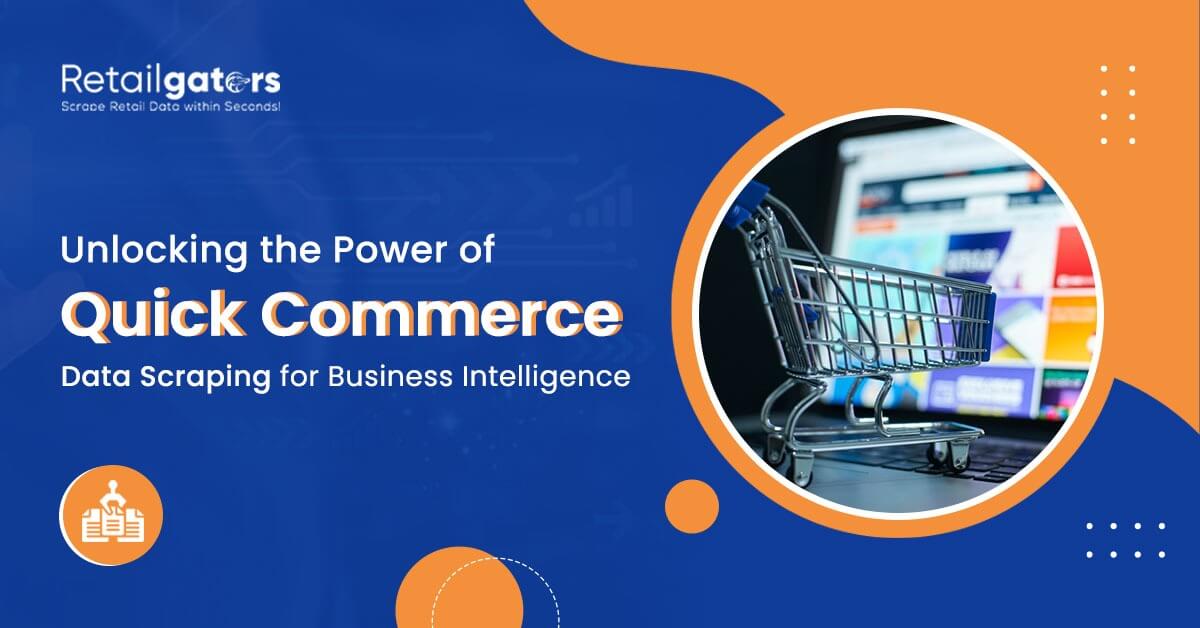
The quick commerce landscape is evolving daily at an unprecedented pace. It has not only shaped customer expectations but also accelerated digital transformation. With the busy urban lifestyle, people are seeking higher convenience, which has led to 10-30 minute delivery of household essentials, groceries, and food. The excessive customer demand has created competition in the retail marketplace. Data here is a key component for fast delivery service providers, improving market awareness, enhancing strategic agility by facilitating decisions, and identifying trends.
Businesses today cannot rely on internal data because it is often outdated, incomplete, or unreliable. Platforms like Swiggy Instamart, Blinkit, and Gopuff contain comprehensive pricing, products, and customer data that enable retailers to drive innovation forward. A quick commerce data scraping service helps online sellers accurately collect large-scale market insights. RetailGators helps businesses to achieve this goal through cutting-edge technologies. Let’s see how quick commerce web content can unlock deeper insights that drive business growth.
Understanding Quick Commerce Data Scraping
What Is Quick Commerce Data Scraping?
Quick Commerce data scraping is the automated extraction of data from various fast delivery service providers’ platforms, ranging from hybrid delivery platforms, integrated Q-Commerce apps, to direct-to-consumer apps and dark store managers.
Difference Between E-Commerce Data and Quick Commerce Data
Though e-commerce and quick commerce are related, their data differ from each other. This can be understood from the following aspects.
| E-Commerce Data | Quick Commerce Data |
|---|---|
| E-commerce data extraction has a broad regional focus. | Quick commerce data covers a micro-local neighbourhood. |
| It provides slower and periodic updates of prices and inventory. | It provides real-time and frequent changes. |
| Online store data focuses on standard delivery timelines. | Q-commerce data focuses on ultra-fast minute-based delivery. |
| It offers a wider location-based catalog. | It offers a highly localized catalog where stock varies by area. |
Key Data Sources in the Quick Commerce Ecosystem
The important data sources that are available in quick commerce are as follows:
- Quick Commerce Marketplace: Swiggy Instamart, Blinkit, Amazon Fresh, etc. are hyperlocal convenience delivery apps.
- Retail and brand listings: These sources are product catalogs and brand visibility. It shows regional availability and category distribution.
- Customer Interaction Data: This data includes customer feedback, ratings, and reviews. It indicates product popularity and demand.
Why Quick Commerce Data Scraping Matters for Business Intelligence
Q-Commerce data scraping is a powerful tool that retailers can use to transform raw data into actionable insights to lead in the market.
Competitive Pricing Intelligence
Monitoring Real-Time Price Changes
Web scraping enables businesses to adjust their prices dynamically to stay relevant. By monitoring price changes, retailers and online delivery stores can smartly manage their stock levels and fulfill customer needs. With competitive pricing intelligence, firms can also spot price fluctuations across regions and stay market relevant.
Optimizing Pricing Strategies
Q-Commerce platforms can optimize pricing strategies to price better and keep your customers happy. It helps brands to build value and strengthen market position. By extracting data from a competitor’s website, firms can improve satisfaction and build loyalty.
Promotion and Marketing Insights
Tracking Competitor Promotions
Brands can track delivery speed to identify their market positioning and adopt technology to keep pace with the industry. It enables them to develop supply chain strategies to optimize logistics. Stores can scrape web data to develop supply chain strategies and optimize logistics.
Improving Inventory Planning
Large-scale organizations can use scraped insights to track demand in real-time and stock the right product. It allows them to monitor fast-moving items to avoid stockouts. By detecting slow movers, retailers are able to reduce the chances of excess stock.
Key Business Intelligence Metrics Extracted From Quick Commerce Data
Customer Sentiment and Feedback Analytics
You can utilize the following Q-Commerce data for customer sentiment and feedback analytics.
- Review Sentiment Score: It helps gauge product satisfaction.
- Rating Distribution: This metric spot quality consistency.
- Complaint Categories: It enables organizations to identify recurring issues.
- Response Time Impact: This helps retailers to assess service perception.
- Social Media Mentions: These are social media tags, brand and company names, enabling the detection of recurring issues.
Product Level Insights
You can extract the following product-level insights from any quick commerce platform:
- Stock Turnover Rate: This metric effectively measures inventory efficiency.
- Sales Velocity: It helps to identify fast-moving items.
- Regional Demand Trends: It can spot location-specific favorites.
- Return Frequency: This is the frequency that highlights quality or fit issues.
Platform and Logistics Insights
By scraping a quick commerce website, you can gather the platform and logistics insights as mentioned below:
- Order Fulfilment Rate: With this metric, organizations can measure delivery reliability.
- Average Delivery Time: This quick commerce data metric allows retailers to track speed efficiency.
- Stock Availability Ratio: It helps brands monitor platform readiness.
Technical Framework of Quick Commerce Data Scraping
- Automated Data Scraping Systems: Data scraping is an automated process. It does not require human interaction. This system can extract a large amount of data in a limited time. Moreover, it has a feature that enables you to collect accurate data without any issues.
- Anti-Bot & Proxy Management: Data scraping systems rotate proxies and mask IPs to ensure anonymity. Modern data scraping tools mimic human use and limit request rate.
- Data Cleaning and Normalization: Web data scrapers provide data in clean formats so that you can interpret it in a better way. It provides reliable insights to drive smarter decisions.
- Data Warehousing & Storage: Quick commerce data scraper uses centralized storage to ensure consistency and easy access. It delivers data in standardized formats such as JSON, API, CSV, XML, and more.
- Business Intelligence Dashboard Integration: Web data scrapers can integrate collected information into the BI dashboard, internal analytics system, or Tableau. It boosts real-time visibility and helps you identify bottlenecks quickly. Q-Commerce data extraction tools help you spot emerging patterns.
Business Use Cases of Quick Commerce Data Scraping
The use of quick-commerce data scraping varies across businesses.
Dynamic Pricing Optimization
Online businesses can opt for quick commerce data scraping to match demand levels and maximize revenue. Organizations can segment customers to personalize their pricing and tailored offers. It helps them to optimize profit margins to boost overall earnings.
Product Assortment Strategy
FMCG brands can scrape quick commerce data to track demand trends and identify popular items. It enables them to monitor the competitor mix to benchmark product variety. Retailers can take advantage of automated data extraction systems to analyze regional needs to localize the assortment strategy.
Market Expansion Strategy
Data collection empowers e-commerce retailers and sellers to map regional demand and identify new markets. It enables brands to check competitor presence and benchmark product variety. They can map the supplier network to strengthen local sourcing.
Competitor Monitoring
Web Scraping for competitor monitoring in Quick Commerce provides numerous advantages. It empowers retailers to quickly adapt to changes to stay relevant. The fast data collection enables logistics managers to drive decision confidence and support data-driven moves.
Challenges in Quick Commerce Data Collection
Although quick commerce data collection provides a competitive Advantage in Retail and other sectors, it has some challenges.
Platform Anti-Bot Protection
Online Q-Commerce stores protect their content by using cybersecurity solutions. They implement some techniques, such as CAPTCHA and rate limiting. This problem is solved by completing the CAPTCHA verification prompt and slowing down the request frequency. The major issue businesses face is API throttling. To overcome this, businesses should implement retry logic.
Dynamic Data and Frequent Updates
Competitors are updating their data dynamically to provide fresh information and keep visitors interested. When you scrape data from any website, you need to use headless browsers such as Puppeteer, Playwright, Chrome, or Firefox. Always schedule regular web scraping for quick commerce to ensure you receive updated data.
Data Standardization Issues
Information gathered from different sources is always in an inconsistent format. The example of a common date mismatch can be MM/DD/YY vs DD/MM/YY, while a currency mismatch can be USD vs EUR vs INR. It creates difficulty in analyzing and researching, a problem solved by establishing clear rules or processes.
Best Practices for Scalable Quick-Commerce Data Scraping
To get the best result when collecting web data, you can follow the following approaches:
- Secure sensitive data to protect compliance.
- Use cloud-based infrastructure for data storage to handle growing data.
- Validate the schema to avoid pipeline breaks, maintain the accuracy level, and ease integration.
- Monitor the dashboard so that you can easily track performance.
- Always process data in batches for ease of handling large volumes.
- Follow security protocols to protect sensitive data.
- Optimize resources to lower infrastructure costs.
- Check data validation for improving quality and accuracy.
How RetailGators Helps Businesses Unlock Quick Commerce Intelligence
Enterprise Quick Commerce Data Solutions
RetailGators offers the best real-time data scraping services and manages increasing data volume. It helps you integrate collected data into the existing system. The organization uses an AI-driven solution to automate extraction and save manual effort.
Business Intelligence Integration
The organization has an experienced professional who integrates data into the BI dashboard. These professionals provide readymade data, which the analytics team can feed directly into existing systems.
The Future of Quick Commerce Data Intelligence
AI-Powered Retail Analytics
Future AI models will be able to forecast demand in real-time to anticipate customer needs. It will have the capability to identify personalized shopping data and provide a tailored offer instantly. Artificial Intelligence will detect fraud and secure digital transactions.
Hyperlocal Retail Intelligence
The modern system will focus on the neighbourhood demand trend and tailored product availability. It will forecast the micro-market to predict sales accurately. The contemporary approach will provide real-time local inventory data to reduce delivery delays.
Real-Time Competitive Monitoring
The latest scrapers will forecast competitor trends to anticipate rival strategies. They will be able to scan promotions in real-time and respond instantly to offers. In the future, the development of an automated system will enable rapid decision-making. The agile strategy will be adopted for improving responsiveness.
Conclusion
In the digital era, quick commerce generates valuable data that helps online food, grocery, and household product sellers to boost revenue, manage stock, understand buyers, and improve delivery speed. Data scraping helps to automate your manual collection tasks and convert them into actionable insights for your business. Schedule your consultation today to transform your organization and align goals with technology and automation by contacting RetailGators.