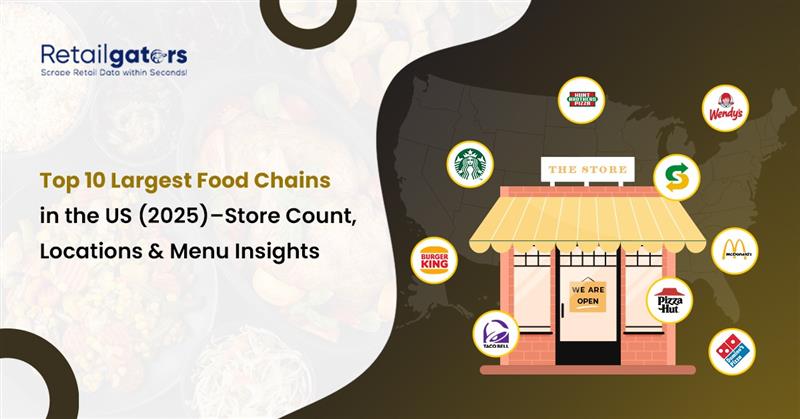
Food chains are becoming sought after in short periods of time because of the increasing fast food demand, quick service speed, affordable pricing, and consistent quality. Fast-food dominance is shaping American culture. Because of high competition, they have to either compromise on their service or price. This affects their sustainability in the US market. This issue can be solved only by knowing which brands are dominating the market in 2025. This is helpful for restaurants to develop more sustainable businesses. In this blog, we will discover the top 10 largest food chains in the USA, their store count, locations, and menu. We will also see how brands can use this data.
The importance of Store Count & Location Footprint in 2025
In 2025, store count & location footprint are a competitive moat because of the following factors:
-
Wide Store Presence: Store presence is an important factor in everyday life. Its widespread availability helps people gain easy daily access to food items. The food chain’s marketing approach ensures high visibility, which drives strong brand recall. They have covered the densest areas to reach customers fast. Some restaurants have a nationwide presence with a strong market dominance. Their presence shows that food is accessible anytime with a convenience edge.
-
Economies of Scale: In 2025, bulk purchasing power is effective in increasing sales and reducing ingredient costs. The centralized logistics of food chains lead to streamlined distribution. Today, restaurants have shared marketing spend, and they have a wider brand reach. They have adopted standardised processes that provide consistent quality output. Because fast food chains have a large workforce pool, they can maintain efficient labour use practices.
-
Regional Dominance: Fast food or full-service restaurants adopted local traditions for cultural dining relevance. If we consider a simple French fries or a burger, they are all-time favourites for Americans. People living in high-density areas have demanded coffee and donuts as their morning meal. To fulfill their demand, many fast-food chain brands achieved the best regional identity fit, a strategy that helps them increase long-term brand loyalty.
-
Delivery Coverage: Top food chains have established numerous locations within a wide geographical area; therefore, they can offer shorter delivery times. Localized distribution of these restaurants helped people reduce wait periods. They have developed multiple delivery hubs to efficiently handle orders. Integrated logistics of fast food chains have created streamlined operations. They emphasize technology to track delivery drivers in real-time. QSRs partnered with delivery fleets to expand their service capacity.
How to Build the 2025 Ranking Using Data & Methodology?
If QSRs want to build a strong ranking, they need to leverage the following competitor data:
-
Location Databases: This is used to map the geographic footprint.
-
Industry Surveys: It is required to cross-check chain presence.
-
Menu Analysis: This analysis is useful to identify key offerings.
-
Financial Disclosures: Financial disclosures are utilized to assess revenue strength.
-
Market Research Firms: These firms can help you compare growth trends of fast food chains.
-
Consumer Insights: These insights are a powerful source to evaluate brand loyalty.
-
Regional Studies: They can effectively measure local dominance.
-
Supply Chain Data: This data is utilized to analyze the cost advantage.
-
Tech Adoption Metrics: It is a key factor for digital readiness.
-
Delivery Coverage Statistics: Such statistics help to assess fulfillment speed.
Top 10 Largest Food Chains in the US in 2025
Let’s discover the top 10 largest food chains in the US in 2025 and understand their analytics.
| Position | Name of Brands | Number of Locations | States Present In | Cities Present In | Menu Insights |
|---|---|---|---|---|---|
| 1 | Subway | 20,378 | 50 | 6,645 | Customizable sandwiches |
| 2 | Starbucks | 17,186 | 50 | 3,800 | Coffee & bakery items |
| 3 | McDonald's | 13,658 | 50 | 5,074 | Burgers & breakfast combos |
| 4 | Hunt Brothers Pizza | 10,489 | 50 | 4,529 | Grab-and-go pizzas |
| 5 | Taco Bell | 8,101 | 50 | 3,599 | Tex-Mex specialties |
| 6 | Domino's Pizza | 7,108 | 50 | 3,660 | Delivery-focused pizzas |
| 7 | Pizza Hut | 6,739 | 50 | 3,188 | Dine-in pizza meals |
| 8 | Burger King | 6,606 | 50 | 3,211 | Flame-grilled burgers |
| 9 | Wendy's | 5,968 | 50 | 2,822 | Fresh beef burgers |
| 10 | Dairy Queen | 4,134 | 50 | 2,667 | Ice cream & fast food |
Geographic Insights
In this section, we will see the geographic insights of the above top 10 largest food chains:
| Brand | Geographic Insights |
|---|---|
| Subway | This fast food chain has a nationwide sandwich presence. |
| Starbucks | Starbucks has an urban coffee saturation. |
| McDonald’s | This QSR has a global burger footprint. |
| Hunt Brothers Pizza | Hunt Brothers Pizza has rural convenience stores. |
| Taco Bell | This fast food chain offered a suburban Tex-Mex spread. |
| Domino’s Pizza | Domino’s Pizza has dense delivery coverage. |
| Pizza Hut | This restaurant has a family dining area. |
| Burger King | This hamburger chain has an international brand reach. |
| Wendy’s | It has a strong Midwest presence. |
| Dairy Queen | Dairy Queen has a small-town dessert anchor. |
Menu Trends Across Chains
In this section, we will explore popular menus across the top 10 largest food chains mentioned above.
| Menu Trend | Impact Across Chains |
|---|---|
| Plant-based options | This menu has impacted broader dietary appeal. |
| Balanced diet meals | It has attracted wellness consumers. |
| Value meal bundles | It is intended to attract price sensitive dinners. |
| Premium coffee drinks | This menu maintains lifestyle brand positioning. |
| Global flavor fusion | This menu trend has driven diverse taste exploration. |
| Seasonal specials | It has created a limited-time excitement. |
| Digital-only exclusives | This type of menu is used to boost mobile engagement. |
| Snack-size portions | It provides on-the-go convenience to Americans. |
| Customizable menu options | It is used to tailor a meal to customer preferences. |
| Dessert innovations | This menu becomes a sweet loyalty driver. |
| Breakfast expansion | It has captured morning traffic. |
Technology & Innovation
Fast food chains are now staying ahead in the US market. This happens because they have integrated the following state-of-the-art technologies and innovations in their restaurants.
Mobile Ordering Apps
In the US, most people are spending their time within an app. Fast food chains such as Subway, Starbucks, and McDonald’s have developed user-friendly mobile applications to order food with just a few taps. With the mobile app developed by QSRs, people can browse the menu hassle-free. In addition to this, it has also simplified customer choice.
Food ordering mobile applications are developed to provide personalized recommendations to customers. This, in turn, boosts upsell potential. Mobile ordering applications are used to perform contactless transactions, which has made the checkout process faster and more convenient. It has enabled real-time order tracking and improved customer trust.
AI-driven Recommendations
Restaurants integrate AI to answer and handle multiple calls simultaneously. Artificial Intelligence is adopted by most QSRs to smartly predict order patterns, which provides them with a faster service response. Modern fast food chains have utilized AI for customer self- service. It helps customers to seamlessly browse the menu, request orders, and pay bills.
Fast food restaurants adopted AI for seasonal trend analysis to align with demand shifts. With the use of artificial intelligence and web scraping techniques, they gained real-time data insights in order to improve operational agility. Restaurants have optimized their loyalty programs and thereby strengthened retention rates.
Contactless Payments
Restaurants have a tap-to-pay card facility to make the checkout process faster. The integrated mobile wallet for seamless digital payments. With a QR code scanning facility, they can easily settle bill payments. Restaurants utilized secure, encrypted systems to build consumer trust.
Fast food chains provide receipts via WhatsApp. This way, they are handling eco-friendly operations. QSRs accept global payments that provide international convenience. QSRs used fraud detection tools to enhance security measures. Their mobile applications are linked with the top loyalty apps, and customers can directly interact with loyalty programs without leaving the app.
Cloud-based POS (Point of Sale)
Fast food chains use centralized order management to not only streamline their workflow but also improve customer service. They sync transactions in real-time to update operations faster. Fast food chains embrace remote access capability to manage their restaurants anywhere anytime.
Software in restaurants is automatically updated, which effectively reduces IT maintenance. They use secure cloud storage to protect sensitive data. QSRs used the analytics-driven cloud dashboards for smarter menu decisions. These restaurants track staff performance to optimize labor efficiency.
Custom Data Scraper
Modern food chains leveraged a data scraper to collect useful insights from competitors’ sites. These insights help to perform trend analysis and gain competitive awareness. Customer data scrapers automatically extract data from digital platforms and therefore reduce manpower. They are reliable and boost decision-making in a restaurant.
Data scraping tools provide QSRs with real-time updates and ensure that you receive fresh insights. It enables them to monitor competitors for tracking market changes. They are good for menu trend analysis and to identify consumer shifts. It ensures consistent data accuracy, which provides a reliable decision foundation. Restaurants also use data scraping for competitive pricing intelligence.
How Brands Use This Data?
-
Store Count Tracking: Brands track store count to monitor expansion progress.
-
Regional Performance: Brands use location insights and store counts for optimizing their resource allocation.
-
Location Distribution: Restaurants use location distribution data to smartly identify growth hotspots.
-
Menu Item Popularity: QSRs use menu insights to adjust their offerings quickly.
-
Delivery Zone Mapping: Fast food chains use the location data of Hunt Brothers Pizza, Starbucks, Subway, and McDonald's to expand their service coverage.
-
Menu Customization Trends: Food chains use menu data to tailor to religious dietary needs.
-
Cross-Location Comparison: Location data is a powerful source that is used by QUSRs to effectively spot underperforming outlets.
-
Spot Underperforming Outlets: Fast food restaurants use store count, locations, and menu insights to gather a first-mover advantage.
-
Geo-Targeted Insights: QSRs integrate data into their business to localize their marketing efforts.
-
Store Density Analysis: Brands leverage competitors' data to perform store density analysis to balance market saturation.
-
Global Flavor Fusion: It helps fast food chains with diverse taste exploration.
Final Thoughts
If we look at this blog, you will see a store count, locations, and menu insights of the top 10 largest food chains in the US. These data are just not raw facts or figures; they are the most valuable assets of restaurants. This large amount of data can be used by brands or fast food chains to maintain competitive advantages. The synergy between data and technology helps your restaurants to deliver the desired outcome. Retailgators is at the forefront of providing large-scale data scraping services. If you are hoping to discover this service in detail, you can talk to data experts.






Leave a Reply
Your email address will not be published. Required fields are marked